
How Seaweed Is Revolutionizing Sustainable Packaging: Benefits, Innovations, and Industry Insights

Seaweed packaging is a class of sustainable materials derived from marine macroalgae that can form films, coatings, and biopolymers with strong biodegradability and low resource demands. This guide explains how polysaccharides such as alginate and carrageenan are extracted from seaweed biomass, formulated into packaging, and deployed across industries—offering an ocean-friendly alternative to petrochemical plastics. Many brands face rising regulatory and consumer pressure to reduce single-use plastics and microplastic pollution, and seaweed packaging provides a promising solution by combining marine safety, compostability, and regenerative cultivation benefits. Readers will learn what seaweed packaging is, how it is manufactured, the environmental and performance trade-offs versus conventional plastics, who the leading innovators are, current and future applications, and practical steps brands can take to pilot seaweed solutions. The article includes comparison tables, industry application maps, and actionable recommendations for fashion and beachwear brands seeking plastic-free packaging options in the current 2024–2025 market context.
What Is Seaweed Packaging and How Does It Work?
Seaweed packaging refers to materials made from marine macroalgae polysaccharides—primarily alginate from brown seaweeds and carrageenan from red seaweeds—processed into films, coatings, or molded items that act as packaging materials. The mechanism relies on extracted polysaccharides forming gel networks when combined with cross-linkers, plasticizers, or blending polymers, producing flexible films with moderate barrier properties and rapid biodegradability in soil and seawater. These materials offer specific benefits: lower freshwater and arable land use compared with terrestrial bioplastics, inherent marine-safety, and potential for edible or compostable end-of-life options. Understanding the basic conversion pathway from biomass to film is essential for evaluating performance trade-offs and supply chain implications, which the next subsections unpack in practical detail.
What Types of Seaweed Are Used in Sustainable Packaging?
Brown seaweeds (Phaeophyceae) are commonly used for their alginate content, which gels in the presence of divalent cations and forms strong, flexible films suitable for coatings and pouches. Red seaweeds (Rhodophyta) provide carrageenan, a gelling polysaccharide used for thicker film matrices and edible wrappers, while certain green seaweeds may contribute other functional polysaccharides for niche applications.
Different species are chosen for film-forming ability, viscosity, and gelation behavior, which determine barrier and mechanical properties needed by food, cosmetics, or garment packaging. Selecting the right seaweed type informs downstream formulation and processing choices, leading naturally to a summary of how those polysaccharides are turned into workable bioplastics.
This marine macroalga is abundant and requires minimal cultivation resources, making it a sustainable choice for packaging.
Seaweed: A Sustainable Alternative for Addressing Plastic Pollution in Food Packaging
Plastic food packaging contributes significantly to environmental pollution through resource extraction, greenhouse gas emissions, and the persistent accumulation of plastic waste. Consequently, identifying sustainable alternatives is critical for ecosystem protection and resource conservation. Seaweed has recently emerged as a promising sustainable solution to plastic pollution. This rapidly growing marine macroalga, abundant along tropical coastlines, requires minimal cultivation resources. Furthermore, seaweed is rich in valuable polysaccharides, including alginate, fucoidan, carrageenan, agar, and ulva, which can be extracted and processed into biodegradable films, coatings, and wraps. This characteristic enables the development of alternatives to conventional plastic food packaging that are fully biodegradable, derived from renewable resources, and do not persist in landfills or marine environments for extended periods.
Seaweed as a valuable and sustainable resource for food packaging materials, A Nesic, 2024
How Are Seaweed Bioplastics Manufactured?

Manufacturing begins with harvested seaweed biomass that is washed, dried, and subjected to extraction processes—often aqueous or alkaline extraction—to isolate alginate or carrageenan fractions. Extracted polysaccharides are purified, blended with plasticizers, solvents, or complementary biopolymers, and then formed into films via casting, extrusion, or molding; drying and cross-linking steps finalize mechanical and barrier properties. Quality control focuses on molecular weight, gel strength, residual salts, and shelf-life stability, while scale-up requires careful control of raw-material variability and processing conditions. These production steps influence cost, performance, and the environmental footprint, which leads into a comparative view of benefits versus traditional plastics.
What Are the Key Benefits of Seaweed Packaging Compared to Plastic Alternatives?
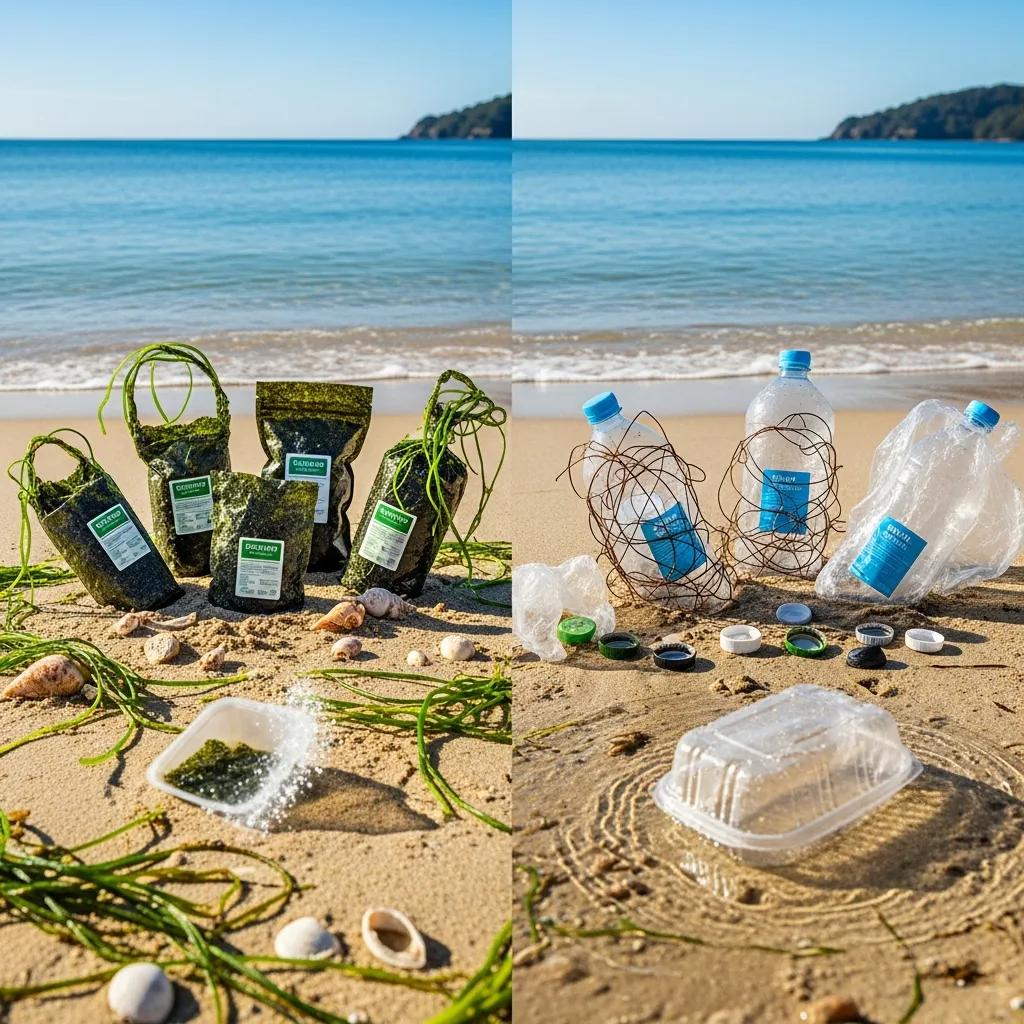
Seaweed packaging delivers several lifecycle advantages compared with petrochemical plastics and certain terrestrial bioplastics, notably rapid biodegradation in marine and soil environments, low dependence on freshwater and arable land, and the potential for regenerative aquaculture to capture carbon.
These benefits translate into reduced plastic pollution risk, smaller resource footprints, and stronger alignment with marine-conservation goals—attributes that are particularly relevant for brands connected to clean seas.
The following table summarizes how seaweed packaging compares across key attributes to conventional plastics and representative bioplastics, helping readers scan trade-offs quickly.
| Material | Biodegradability | Carbon & Resource Footprint | Marine Safety / Microplastic Risk |
|---|---|---|---|
| Seaweed-derived films | High in marine/soil settings; often compostable | Low freshwater/arable land use; supports carbon capture via aquaculture | Low microplastic persistence; materials biodegrade in seawater |
| Conventional petro-plastics (PE/PP) | Very low; persistent | High fossil carbon intensity; high resource extraction impact | High microplastic generation and persistence |
This comparison highlights seaweed packaging’s strengths for ocean-facing use cases while also indicating where conventional bioplastics may still outperform in controlled industrial composting environments. To understand the practical environmental pathways, the next subsection explains how seaweed materials reduce plastic pollution and microplastics.
The inherent properties of seaweed polymers allow for the creation of robust films suitable for various packaging applications, offering a direct alternative to conventional plastics.
Seaweed-Derived Polymers for Biodegradable Bioplastics and Packaging Applications
Seaweed polymers exhibit significant potential for the production of diverse biodegradable bioplastics and biofilms. With these inherent properties, a concentration of 2.75g can yield a highly robust film suitable for numerous environmentally friendly applications in packaging, including but not limited to biscuits, sachets, and seasonings, as well as in the development of carrier bags and plastic bottles.
Biodegradable plastic and film production from seaweeds, 2022
How Does Seaweed Packaging Reduce Plastic Pollution and Microplastics?
Seaweed-based materials reduce plastic pollution by replacing persistent polymers with polysaccharides that are enzymatically degraded by marine microbes and break down to benign organic matter rather than forming long-lived microplastics. The biodegradation pathway involves hydrolysis of polysaccharide chains followed by microbial assimilation, which shortens environmental residence time and lowers fragmentation risk compared with petrochemical plastics. Real-world reductions depend on material formulation, thickness, and use-case—for example, thin film wraps degrade faster than multi-layer composites—so brands should match formats to expected exposure scenarios. Understanding these degradation mechanisms informs design choices that minimize environmental harm while meeting functional needs.
What Makes Seaweed Packaging Biodegradable, Compostable, and Edible?
Biodegradable describes the material’s ability to be broken down by biological processes; compostable adds a requirement for breakdown under defined temperature and microbial conditions; and edible implies safety and palatability for direct human ingestion. Seaweed polysaccharide films are inherently biodegradable and, in many formats, compostable under home or industrial conditions depending on formulation and additives; a subset of thin edible films is safe for ingestion when formulated without harmful additives. Certification and testing are essential to substantiate claims—biodegradability in seawater, home compostability, and food-contact compliance each require different test protocols and documentation. Clear labeling and validated testing help prevent greenwashing and ensure consumer trust in environmental claims.
Which Companies Are Leading the Seaweed Packaging Revolution?
A handful of innovators have commercialized distinct seaweed packaging formats, ranging from edible films to water-soluble pouches and compostable coatings, and they are partnering with brands to pilot applications across food and consumer goods. These companies focus on different solution types, technical strengths, and deployment models—some prioritize food-contact safety while others target single-use event packaging or cosmetic samples. Below is a concise reference table that maps notable providers to their solution types and representative use-cases to help brand teams evaluate partners quickly.
| Company | Solution Type | Notable Use-Cases / Claims |
|---|---|---|
| Notpla | Edible & compostable films/coatings | Single-use food wrappers and cups; marine biodegradability emphasis |
| Sway | Seaweed-based films and pouches | Flexible packaging for dry goods and coatings for moisture control |
| Evoware | Edible wrappers and sachets | Food and beverage wrappers that are compostable and edible |
This table helps procurement and sustainability teams identify candidate partners by format and application, and it shows how different companies emphasize marine safety, edibility, or packaging form factors. After reviewing vendor options, many brands ask how they themselves can pilot seaweed packaging in fashion and retail contexts, which the following micro-case example addresses.
Bongo Beachwear is exploring seaweed packaging partnerships and pilots as part of broader industry innovation; the next paragraph briefly contextualizes how a beachwear brand might fit among these providers. Brands like Bongo Beachwear can leverage partnerships with innovators to pilot garment wraps, sample sachets, or pouch solutions that prioritize marine-safe end-of-life behavior, using vendor strengths—edible films, flexible pouches, or coatings—according to product requirements. A targeted pilot can validate shelf life, moisture resistance, and customer perception before broader rollout, and suppliers typically assist with formulation tuning and small-batch production during early-stage testing.
Seaweed biomass is a valuable feedstock for renewable resources, offering an alternative to fossil fuel-based materials and holding potential for climate change mitigation.
Seaweed Polysaccharides for Bioplastic Production: Extraction, Characterization, and Applications
Seaweed biomass is increasingly recognized as a valuable industrial and economic feedstock for renewable resources, yielding high-value products such as nutraceuticals, value-added chemicals, and bioplastics. These organisms can be cultivated sustainably on an industrial scale, offering new avenues to reduce our reliance on fossil fuel-based feedstocks. Furthermore, they hold potential for climate change mitigation while alleviating pressure on terrestrial resources. Seaweed typically exhibits a high polysaccharide content, positioning it as an alternative source to crop plants for bioplastic production. Polysaccharides like alginate, carrageenan, ulvan, fucoidan, and laminarin are suitable candidates for bioplastic components due to their compatibility with diverse matrices and film-forming capabilities. A broad spectrum of applications for these polysaccharides has already been established in biomedical fields, food packaging, functional foods, nutraceuticals, and the pharmaceutical industry. Composites and blends of these polysaccharides with other polymers...
Seaweed-based polysaccharides–review of extraction, characterization, and bioplastic application, M Kumar, 2024
What Solutions Do Notpla, Sway, and Evoware Offer?
Notpla focuses on thin edible and compostable films and molded containers designed for single-use food service and on-the-go applications, emphasizing materials that biodegrade rapidly in marine environments.
Sway develops flexible seaweed-derived films and pouches with enhanced handling properties for dry and shelf-stable goods, targeting brands seeking low-water-footprint packaging with reasonable shelf-life.
Evoware offers edible wrappers and sachets aimed at food and beverage uses where direct consumption or immediate composting is acceptable, positioning their products for convenience and zero-waste events.
How Is Bongo Beachwear Integrating Seaweed Packaging Into Sustainable Fashion?
Bongo Beachwear is piloting seaweed-based packaging formats such as thin garment bags, inner wraps, and compostable tags to reduce plastic waste associated with beachwear shipments and retail displays.
Practical applications include seaweed-film garment sleeves that protect wet or sandy items during transit, branded inner wraps that are compostable after use, and sample-size sachets for sunscreen or fabric-care products using edible or compostable films where appropriate.
Operational considerations include moisture resistance testing for wet swimwear, printability for branding, and integration with existing fulfillment processes to maintain pick-and-pack efficiency.
Early pilots should measure customer feedback, shelf-life performance, and end-of-life behavior to guide scale decisions.
What Are the Current Applications and Future Innovations in Seaweed Packaging?
Seaweed packaging is actively used in food service (wrappers, pouches, coatings), cosmetics (sample sachets, soluble pods), and emerging fashion applications (garment bags, tags), with R&D pushing toward improved tensile strength, barrier properties, and scalable extrusion techniques.
Industry adoption today tends to prioritize single-use scenarios with short exposure timelines or where marine-safe end-of-life is critical, but material science advances are extending applicability to higher-performance needs. The following industry map table links sectors to typical packaging formats and notes key performance constraints to help product teams prioritize pilot projects.
| Industry | Packaging Format | Performance / Constraints |
|---|---|---|
| Food | Films, pouches, edible coatings | Shelf-life and moisture barriers require formulation tuning |
| Cosmetics | Sample sachets, dissolvable pods | Compatibility with active ingredients and regulatory testing |
| Fashion | Garment bags, tags, inner wraps | Durability, printability, and moisture resistance for apparel |
0 comments